1% for Art: What It Is and What It Means for Baltimore
Most developers working on publicly funded capital projects will encounter a 1% for art requirement early in the planning process. Cities and states across the country direct one to two percent of construction budgets toward permanent artwork at the project site. The percent-for-art model draws its funding from the project budget itself, so every qualifying build generates a dedicated stream of public art funding for the surrounding neighborhood.
More than 350 U.S. cities have adopted this approach since Philadelphia created the first program in 1959. Seattle and San Francisco expanded it into district-wide strategies that reshape entire corridors. Rotterdam and Berlin embedded similar frameworks into their urban development processes, producing cities where new construction consistently delivers public artwork alongside it.
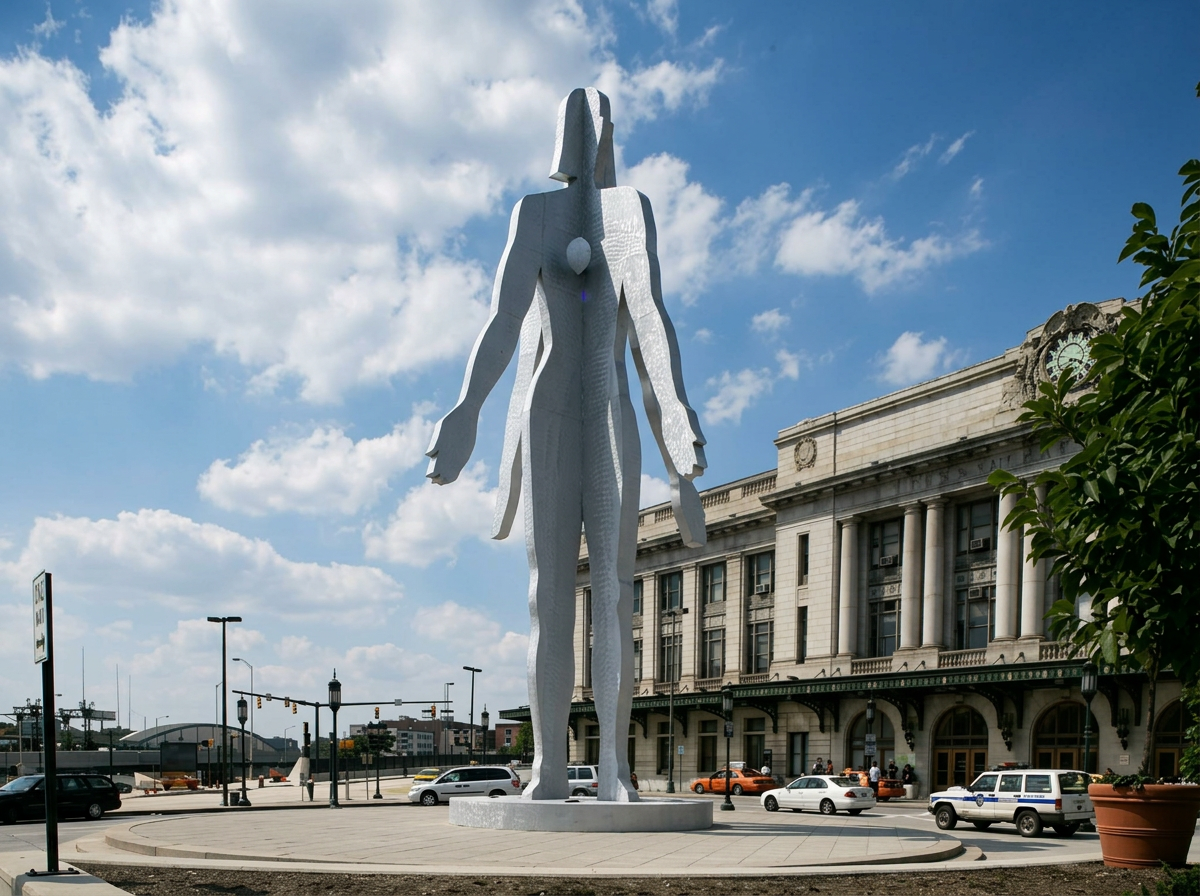
“Male/Female” by sculptor Jonathan Borofsky, installed at Baltimore Penn Station in 2004.
Maryland's Percent for Art Landscape
Maryland's public art requirements vary by project type and funding source. Baltimore City's Public Art Commission mandates a percent-for-art allocation on all city-funded capital projects. The Maryland State Arts Council administers separate guidelines at the state level, and federally funded buildings fall under the GSA's Art in Architecture program. Private developers increasingly adopt voluntary commitments tied to PILOT (Payment in Lieu of Taxes) agreements or TIF (Tax Increment Financing) investments.
Each jurisdiction sets its own documentation and compliance reporting standards. When multiple layers apply to a single project, developers face real coordination challenges on already tight construction timelines.
What Developers Gain from a Strong Commission
The Henrietta Lacks Mural in Middle East, Baltimore shows what a well-executed Baltimore public art commission can produce. Artist Shawn Perkins received $40,000 of the $75,000 total commission directly, keeping the investment rooted in Baltimore's creative economy.
Nosreme designed workshops and community events around the project, bringing more than 200 neighborhood residents into the process and building real relationships between the development and the people who live around it. Three editorial press features followed the unveiling, giving the project a public narrative shaped by culture and community.
For developers navigating entitlements, community sentiment, and public visibility, that kind of outcome turns a line-item obligation into one of the strongest assets in a project's story.
How Nosreme Delivers a 1% for Art Commission
Nosreme manages percent-for-art commissions from intake through installation and compliance reporting. Because the organization works with a registry of 35-plus Baltimore-based artists, the matching process moves quickly, and the artist who gets the commission already understands the city, the neighborhoods, and the communities they'll be working with. Once an artist is selected, Nosreme coordinates design and fabrication on the same timeline as your construction schedule, so the artwork integrates with the build rather than delaying it.
As a 501(c)(3) nonprofit, Nosreme's success is measured by the same outcomes your community stakeholders care about: paid local artists, resident participation, and permanent work that strengthens the neighborhood. That alignment is what makes the partnership work for developers navigating public approvals and community sentiment.
If your capital project has a percent-for-art allocation in development or is already committed, the right time to bring Nosreme in is during planning. Connect with us for an initial scoping conversation today.